 Skip to content

Home › Factory & Capabilities › Mold Making
Mold Making · ±0.01 mm · Molds up to 1.5 m
Injection Mold Making in China: In-House Tool Shop, ±0.01 mm, Molds up to 1.5 m
Hongqing designs and builds injection molds in its own tool shop in Qiaotou, Dongguan, China, with Sodick EDM, Sodick wire EDM and Makino high-speed machining centers working to ±0.01 mm on molds up to 1.5 m. Molds are usually S136 steel rated for 500,000 shots, trials run on our own 80T–1300T presses, tooling takes from 30 days, and the mold belongs to you.
We'll sign an NDA before you send drawings · Or email info@dghongqing.com
Last updated: October 2026
±0.01 mm machining
Molds up to 1.5 m
S136 steel · 500,000 shots
You own your molds
Tool shop specs
Mold making at a glance
These figures match our factory page, and you can check each one during a factory visit or video audit.
Equipment
Sodick EDM, Sodick wire EDM, Makino high-speed machining centers and more
Machining accuracy
±0.01 mm
Mold size
Up to 1.5 m, for large housings, appliance parts and automotive components
Mold features
Slides, lifters, inserts, undercuts and multi-cavity; two-shot and insert molds
Steel and tool life
Usually S136 steel rated for 500,000 shots; other steels can be discussed for lower volumes
Mold trials
Run on our own 80T–1300T presses (T1–Tn), with samples shipped for your approval
Lead time
Tooling from 30 days; the full schedule is given in writing after we review your 3D files
Ownership
The mold is yours under the contract and can be moved out if needed
Payment
Tooling starts after a 50% deposit; the remaining payment milestones are set in the contract
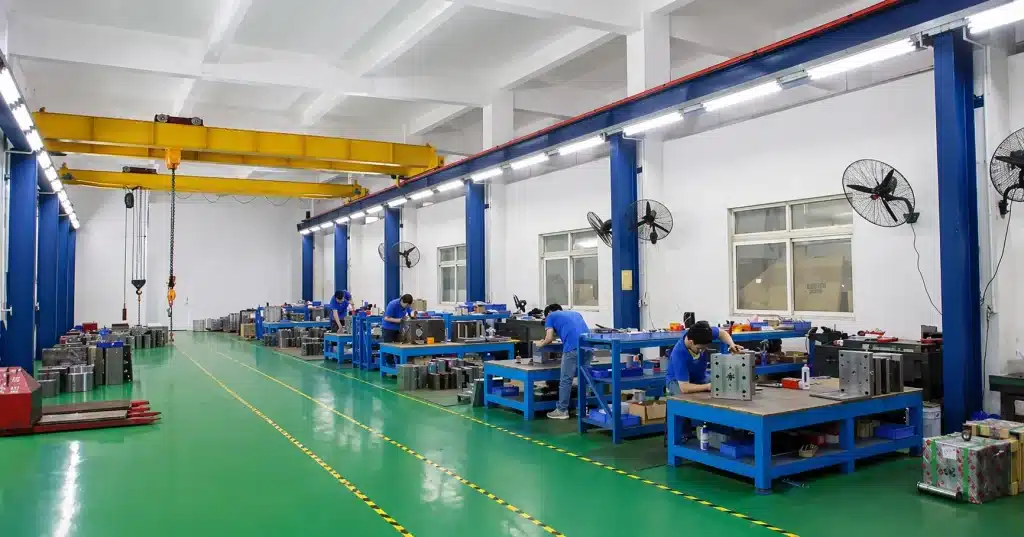
Hongqing's in-house tool shop, photographed at our Qiaotou, Dongguan plant
DFM review
Fix problems in the design before cutting steel
Once we have your 3D files, Hongqing's engineers issue a DFM report that flags anything likely to cause sink, warpage, flash or ejection problems; changes are approved by you before tooling starts.
01
Wall thickness
Wall thickness and sink
We check for even walls and overly thick ribs and bosses to prevent sink, warpage and internal stress.
02
Ejection
Draft and undercuts
We confirm draft on every face and solve undercuts with slides or lifters, or suggest design changes, so parts eject cleanly.
03
Form
Parting line and gates
We set the parting line, gates and vents so weld lines and gate marks stay off cosmetic surfaces.
04
Production
Ejection and cooling
Ejector and cooling channel layout affects dimensional stability and cycle time, and therefore the part price.
Tooling process
From DFM to production: 6 milestones of mold making
Tooling takes from 30 days; the full schedule is given in writing after we review your 3D files, and every milestone that needs your approval is confirmed before we move on.

EDM area: fine details and sharp corners of each mold are machined here
1
DFM review and quote
We run a DFM review of your 3D files and issue a written USD quote based on part size, cavity count, steel, number of slides and lifters, surface texture, and whether the part is two-shot or overmolded.
2
Mold design
Our engineers design the mold: parting, gating, ejection, cooling channels and insert layout, plus the steel and machining plan.
3
Precision machining
Makino high-speed machining centers cut the cavity and core, Sodick EDM machines fine details and sharp corners, and Sodick wire EDM cuts inserts and precision fits to ±0.01 mm.
4
Assembly and T1 trial
The assembled mold is trialed on our own presses and T1 samples are shipped to you to approve appearance, dimensions and fit.
5
Mold adjustment and sample approval
We adjust the mold and trial again (T2, T3…) until the samples pass; adjustments are made in our own tool shop, so the mold never travels between factories.
6
Production and maintenance
Once samples are approved, the mold moves into production in our molding shop, and our tool shop handles routine maintenance and repairs; the mold is yours and can be moved out if needed.
Tool shop capability
4 key numbers from our tool shop
You can see the equipment and records behind every number during a factory visit or video audit.
±0.01 mm
Machining accuracy (Sodick, Makino)
1.5 m
Maximum mold size
500,000 shots
Tool life with S136 steel
From 30 days
Tooling lead time, with the schedule confirmed in writing
Mold pricing
6 factors that drive injection mold cost
Hongqing quotes molds per project: after reviewing your 3D files we issue a written USD quote with the DFM report attached; part prices are quoted separately.
01
Part size
Larger parts need larger mold bases and more steel, and take longer to machine; we build molds up to 1.5 m.
02
Cavity count
More cavities cost more up front but produce more parts per cycle and lower the part price; annual volume decides the count.
03
Steel grade
We usually use S136 steel rated for 500,000 shots; for lower volumes, other steels can keep tooling cost down.
04
Slides and lifters
More undercuts mean more slides and lifters, which make the mold more complex to design and machine.
05
Surface texture
High-gloss polish, textures and similar finishes add cavity machining and treatment cost.
06
Two-shot or overmolding
Two-shot and insert molds are more complex and run on our two-shot and vertical presses respectively.
Tool shop photos
Inside our tool shop
These photos were taken at Hongqing's factory in Qiaotou, Dongguan; you will see the same tool shop and equipment during a factory visit or video audit.

Sodick EDM
Machines mold details, narrow slots and sharp corners.

Sodick wire EDM
Cuts inserts and precision fits to ±0.01 mm.

Wire EDM area
Wire cutting for mold inserts and precision components.

CNC machining center
Machines mold cavities, cores and plates.
Before and after tooling
Design, prototyping, molding and QC on the same site as the tool shop
Files go from design to the tool shop, and molds go from the tool shop to the molding floor, all inside our plant; trials and adjustments never require shipping the mold between factories.

Injection Molding
90+ presses from 80T to 1300T; mold trials and production both run in our own factory.
Explore injection molding →
Prototyping
Verify appearance, dimensions and fit with 3D-printed or CNC prototypes before tooling; prototypes from 10 days.
Prototyping →
Product Design & Engineering
Mechanical design follows molding rules from the start, so fewer changes are needed after tooling.
See design and engineering →
Quality Control
A 20-person QC team inspecting at four gates: incoming, first article, in-process and outgoing.
Explore quality control →
Does Hongqing build its own molds, or outsource them?
Hongqing builds its injection molds in its own tool shop in Qiaotou, Dongguan, where mold design, precision machining to ±0.01 mm, assembly, trials and adjustments all happen in-house. The shop runs Sodick EDM, Sodick wire EDM and Makino high-speed machining centers, and trials take place on our own 80T–1300T presses. Finished molds go straight into production in our molding shop, adjustments are also made in-house, and the mold never travels between factories. If any step in your project needs outsourcing, such as plating, we tell you at the quotation stage.
How does Hongqing decide how many cavities a mold should have?
Hongqing sets the cavity count in the DFM review based on 4 factors: annual volume, part size, tolerance requirements and budget. For small parts at high volume, multi-cavity molds lower the part price but cost more up front; large parts, tight tolerances or modest volumes usually suit one or two cavities, which keep tooling cost lower and dimensions easier to control. Matching parts with similar look and structure can also be evaluated for a single shared mold. The cavity count is stated in the DFM report and quote, and we can quote two cavity options side by side if you want to compare.
What should I confirm before tooling to avoid mold changes later?
Hongqing recommends confirming 5 details before tooling: cosmetic surfaces and where marks are acceptable, parting line location, gate locations, ejector pin locations, and draft angles and surface texture. All of these are listed in the DFM report for you to approve before tooling starts; changing them after the mold is cut usually means rework or added inserts, which costs time and money. If your product is still in design, verify appearance, dimensions and fit with a 3D-printed or CNC prototype first, available from 10 days.
How do two-shot and insert molds differ from standard injection molds?
Hongqing's two-shot and insert molds both add a molding step compared with a standard single-material mold, so they need dedicated presses. Two-shot molds run on our 7 two-shot presses, injecting two materials in sequence in one tool so soft material bonds to a rigid base; insert molds run on our 5 vertical presses, where nuts, terminals or metal parts are placed in the mold before plastic is molded around them. Both must account for material bonding, insert location and shrinkage, so they cost more than standard molds, but they remove assembly steps and make a stronger part. We advise whether you need one in the DFM review, based on your design and cost targets.
Send us what you have. We'll map out the route to mass production.
Wherever you are in development, we'll propose the right manufacturing plan, from early design review through tooling and molding to finishing, assembly and shipping, and move your project step by step to mass production.
Helpful to include: sketches, drawings or 3D files, annual volume and target market.

 Chinese
 English
 Spanish
 Russian
 Italian